Commercial and Business Insurance Claims in Michigan
A rebuild costs what the bids say,
Commercial losses get scoped with the same software and the same afternoon as a residential claim, and then priced off a number rather than off what the work will actually cost to put out to bid. Meanwhile the building is only half of it, because the business inside it has stopped.

A commercial loss is two claims,
The structure. Repair or rebuild scope for the building itself, priced against what contractors will actually charge to do the work.
Equipment, fixtures and inventory. What was in the building, what it was worth, and what replacing it costs now.
Business interruption. The income the business loses while it cannot operate, and the expenses that keep running anyway. After a fire, see business fire insurance claims.
Extra expense. What it costs to keep trading: temporary premises, rented equipment, overtime, expedited freight.
Six ways a commercial claim gets smaller than it should be
Read these against the estimate you have been handed.
An estimate is a number. A rebuild is a project.
An estimate produces a figure from software. The rebuild gets bid by contractors from what the job actually requires. Settle from the figure rather than the bids and the gap is not a rounding error.
The period of restoration
Your policy pays for the time it should reasonably take to reopen. Someone decides what reasonable means, and that caps the income claim however long it actually took.
Extra expense, never claimed at all
Separate coverage from business interruption, and the one owners most often do not know they have. Temporary space, rented equipment, overtime, expedited freight. Spent whether or not anyone claims it.
Code a commercial building carries
Repairs to a commercial structure can trigger requirements a house would never face. Whether your policy responds is a question worth answering before the rebuild starts rather than after.
Written as the residential equivalent
The commercial version of plaster recorded as drywall, across a bigger building: finishes, fire-rated assemblies and systems all written as the residential-grade version of themselves.
The estimate itself
Like a renovation you priced yourself, the big items are there and look right. Across more square footage and more systems, it is the missing small ones that move the number.
Timing
Your policy has deadlines you didn't negotiate.
Notice of loss, proof of loss, and a limit on how long you have to bring suit. All of them run from the date of loss, not from the day the insurance company gets back to you. Most people never learn what theirs are until one has already passed.
Some of those deadlines are set by state law rather than by your policy. In Michigan, here is how they work.
Right now
Pull your numbers before you need them.
Photograph and inventory everything before any cleanup starts. Pull your profit and loss statements, payroll, and monthly revenue going back two years now, while your bookkeeper still has time to do it properly. Start a daily log of what you cannot do and what it is costing you, because it is tedious and it is the most useful document you will have. And do not give a recorded statement about your income until those numbers are built.
Working with us
What we actually do.
We document the building the same way we document any loss, then price the rebuild against what contractors will bid rather than what the software returns. Then we build the income claim, which is usually the part that decides the number.
Already have an offer? It is usually not too late.
Claims can be supplemented or reopened, and a low first offer is the most common reason people call us. If a check has already been cashed, that is not necessarily the end of it either. If the offer is fair, we will tell you that.
What this costs you.
Nothing up front. We work on a contingency fee, which means we are paid a share of what we recover for you, and not until you recover. The number goes in writing before any work starts. If we look at your claim and do not believe we can add enough to be worth our fee, we will tell you, and that conversation still costs you nothing.
Questions
Does business interruption coverage pay if we could still partly operate?
Often, yes. Business income coverage usually pays for a drop in income, not only a full shutdown, as long as the slowdown comes from the physical damage. That makes a daily record of what you could not do, and what it cost you, the center of the claim.
What is coinsurance, and can it reduce a commercial claim?
Many commercial property policies require the building to be insured to a set share of its value. If the limit you carried falls short of that share at the time of the loss, the payment is cut in proportion, even on a partial loss. It is one of the first things to check on a commercial claim, because it changes every number after it.
Does business income coverage stop when the building is repaired?
The basic coverage usually runs for the period of restoration, which ends when the property should reasonably be repaired, not when the business is back to where it was. Many policies add extended business income, which keeps paying for a set number of days after you reopen while customers come back. Check whether yours has it and how long it runs.
We lease our space. Who claims what after a loss?
Usually the landlord's policy covers the building, and the tenant's policy covers the business's own property, its lost income and the improvements it paid for. The lease decides who insures what, including who rebuilds those improvements and whether rent stops while the space cannot be used. Read it before either side tells you it is the other one's claim.
A claim we handled
An offer of $11,630 on a commercial water loss that settled at $113,600.
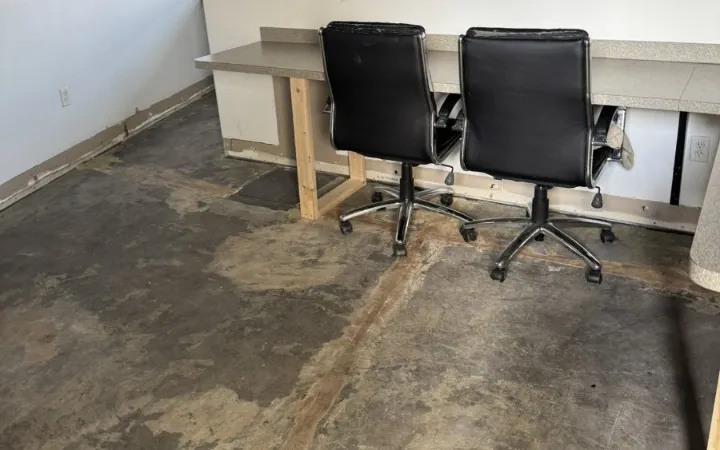
Settled at $113,600. The offer was $11,630.
Water through a Royal Oak office. The scope on the table stopped well short of the building. We itemized it, backed the materials with lab reports, and settled in three months.
Read the full claimBusiness loss? Let's get you back to operating.
Tell us what happened to the building and what it has done to the business. No cost, no obligation.