
Public adjusters in Pontiac, Michigan.
One in five Pontiac homes was built before 1940, and nearly half before 1960. On February 3, 2020 fire tore through the upper floors and roof of the Fitzgerald House, a 1920s home on Ottawa Drive, and left it a total loss. Plaster and old framing raise what a loss here costs.
AdjustFair works only for the policyholder, from our Ferndale office, about 15 miles southeast of Pontiac. We read the policy, document the full loss, price the repair the way a contractor would have to build it, and put that number in front of the insurance company with the proof behind it.
Where claims here get underpaid.
Three kinds of loss drive most serious Pontiac claims, and each one tends to come in short in a familiar place.
- Sewer back-ups in older neighborhoods. In April 2026 residents of Seminole Hills, a historic district of nearly 500 homes laid out in the 1910s and 1920s, described sewer back-ups that had gone on for years, with nearly everyone on one Miami Street block affected. Sewage is category 3 water, so drywall, carpet and anything porous usually has to come out rather than be dried, and a back-up from the public system is often paid under an endorsement with its own, smaller limit. Water from the home's own broken line is a fill-up that started in the house and usually gets the full policy, and a plumber's written cause usually decides which one it was.
- Fire in older houses and apartment buildings. At the Fitzgerald House the flames ran through the upper floors and the roof, and on July 1, 2017 a fire that began in one top-floor unit at West Manor Senior Apartments on South Paddock spread to others and displaced 40 residents. In a house with plaster and old framing, smoke reaches rooms the fire never touched, and an estimate written in drywall and stock trim leaves out what was actually there. In an apartment building the owner's policy and each tenant's policy cover different things, and every household's contents have to be listed item by item.
- Cars into homes. In May 2025 a pickup truck went through the front door and window of an apartment on Firelite Lane and into the living room, and in August 2018 a crash at Whittemore and Sanford pushed a car into a house hard enough that the owner described damage to the foundation. A car that comes through a wall moves more than the wall: door frames, floor framing and the lines inside the walls can shift well away from the opening. An estimate that stops at the hole leaves them out.
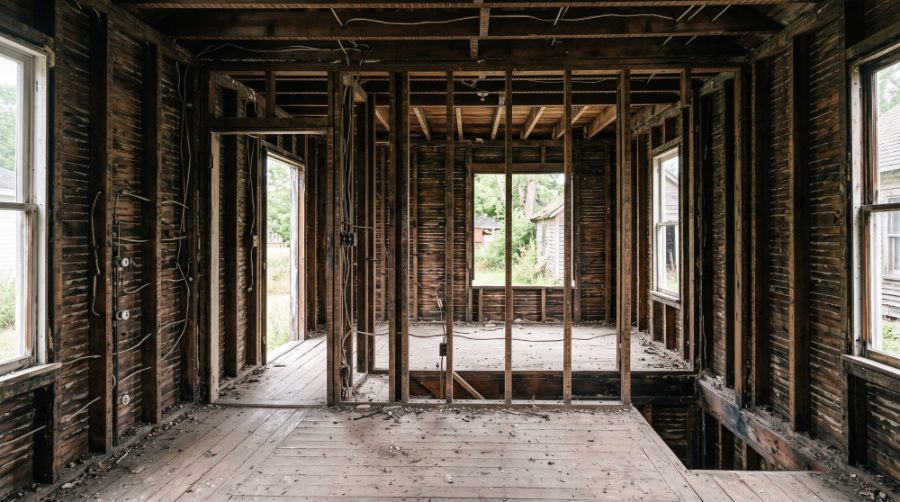
Called two days after the fire, and it never needed appraisal.
A kitchen grease fire put smoke through the house. We were engaged two days after the loss, and the scope was settled by negotiation without appraisal.
Questions we get here.
Sewage keeps backing up into my Pontiac basement. Is there a deadline besides the insurance claim?
If a public sewer caused it, yes. Under Michigan's Public Act 222 of 2001, a claim to the city or county has to be made in writing within 45 days of discovering the damage, with your name, address, the date you found it and a short description. Seminole Hills homeowners filed that kind of notice in 2026. It runs separately from your own policy's back-up coverage.
A car crashed into my Pontiac house. Whose insurance pays?
Often the car's. Every Michigan auto policy carries property protection insurance, which pays up to $1 million for damage a car does to buildings and fences. Report it to your own insurance company too. For either claim, keep the police report, photograph everything before it is boarded up, and make sure the estimate goes past the hole to the framing and foundation behind it.
How soon can an adjuster get to Pontiac?
Pontiac sits at the north end of Woodward, about 15 miles up the same road from our Ferndale office. Call the number on this page and someone will tell you what to photograph and keep before cleanup starts, and when an adjuster can meet you at the house, the apartment building or the storefront.
Nearby
See every city we cover from our Metro Detroit office in Ferndale.
Let's find out where |your claim stands.
Tell us what happened and we'll tell you honestly what your policy covers and what we would do next. It costs nothing to ask.